Best eSIM for Europe in 2026: Multi-Country Plans Compared
Planning a multi-country European trip means solving one critical problem before you board your flight: staying connected across borders without returning home to a shocking roaming bill.
Traditional roaming charges from home carriers can reach $10-15 per day in Europe. Physical SIM cards require finding local shops in each country, swapping tiny chips in airports, and managing multiple phone numbers. The friction eats into precious travel time.
An eSIM (embedded SIM) eliminates these headaches entirely. This guide compares the best eSIM providers for European travel in 2026, examining multi-country coverage, pricing structures, and real-world performance to help you choose the right data plan for your itinerary.

What Is an eSIM and How Does It Work for Europe Travel?
An eSIM (embedded SIM) is a digital SIM card built directly into your smartphone, allowing you to activate a mobile data plan without inserting a physical chip. For Europe travel, this means you can purchase and install a multi-country data plan before departure, connecting to local networks in each destination automatically.
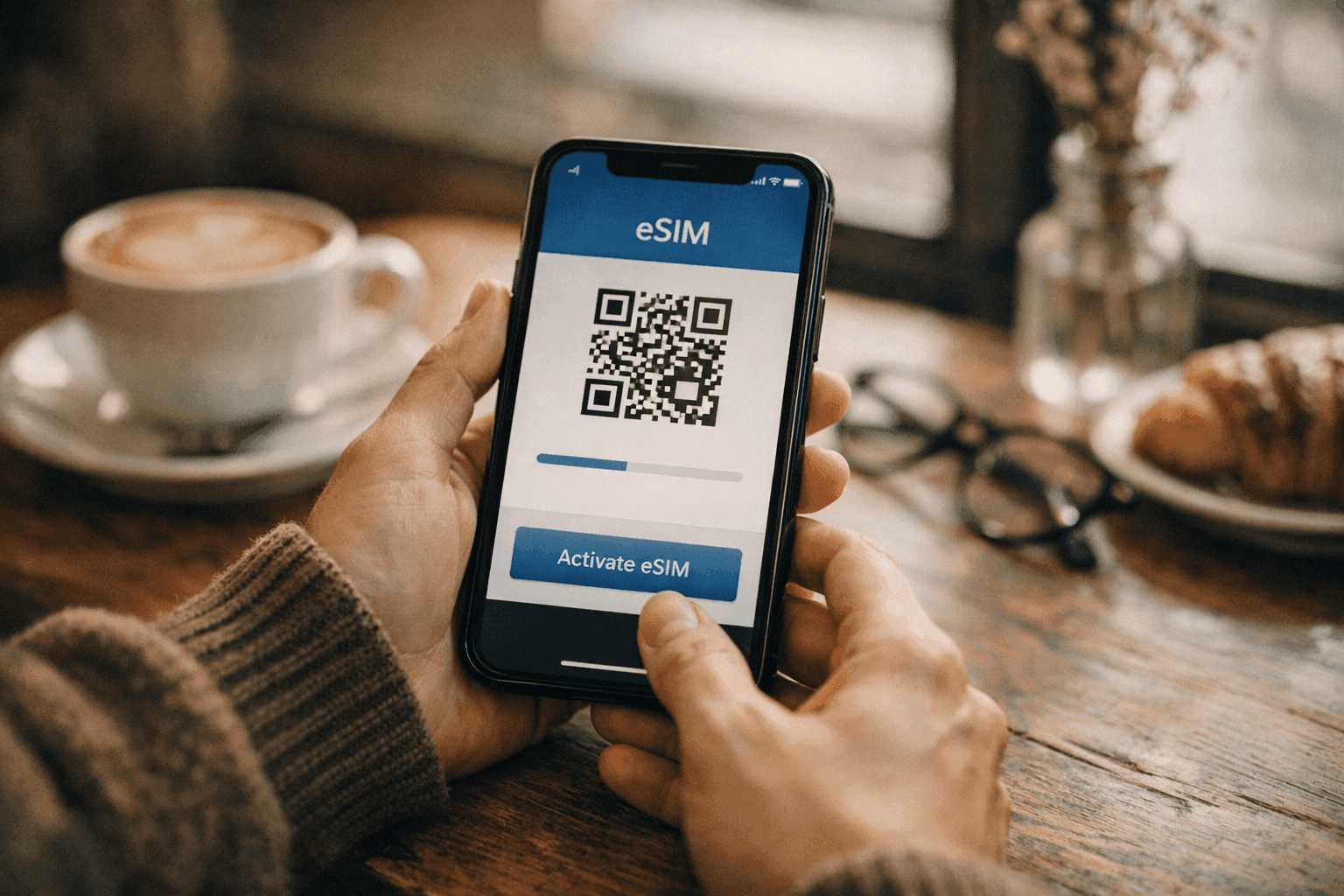
The technology works through a programmable chip soldered onto your device’s motherboard. When you purchase an eSIM plan, you receive a QR code or activation code that downloads a carrier profile to your device. This profile contains the credentials needed to authenticate with partner networks in your destination countries.
For European multi-country trips, eSIMs offer a distinct advantage: a single plan covers 30+ countries. When you cross from France into Germany or board a train to Italy, your connection continues seamlessly. The eSIM automatically switches to the strongest available partner network in each location without manual intervention.
Device compatibility has expanded significantly. According to eSIM-compatible device lists, most smartphones released after 2020 support the technology, including iPhone XS and newer, Samsung Galaxy S20 and newer, and Google Pixel 3 and newer models.

Why Use an eSIM for European Travel in 2026?
Using an eSIM for European travel eliminates roaming fees, removes the need to purchase new SIM cards in each country, and provides instant activation before departure. In 2026, eSIM technology has matured to offer better coverage, faster speeds, and more competitive pricing than traditional roaming or physical SIM alternatives.
The economic case is compelling. International roaming from major carriers typically costs $12-15 per day. A two-week trip could cost $168-210 in roaming fees alone. A comparable eSIM plan for the same duration costs significantly less while offering equivalent or better data allowances.
Beyond cost, convenience drives adoption. Consider the alternative: arriving in London, finding a mobile shop, presenting identification, purchasing a SIM, swapping your physical card (and risking loss of your home SIM), then repeating this process in Paris and Rome. An eSIM removes every step except the initial purchase.
Environmental considerations also matter. Physical SIM cards require plastic packaging, shipping, and disposal. eSIMs are entirely digital, eliminating physical waste. For environmentally conscious travelers, this aligns with sustainable travel practices.
Network quality in Europe has improved substantially. According to Ookla’s Speedtest Global Index, average mobile download speeds across Western Europe now exceed 65 Mbps, with 5G coverage available in all major cities and most rural highways. eSIM providers connect to these same high-speed networks through roaming agreements with tier-1 carriers.
Comparing the Best eSIM Providers for Europe
The three leading eSIM providers for Europe travel are Yoho Mobile, Airalo, and Holafly. Each offers multi-country coverage with distinct pricing models: Yoho Mobile provides flexible data-sharing plans, Airalo offers fixed data packages, and Holafly specializes in unlimited data with speed caps after threshold usage.
Provider Countries Covered Data Options Hotspot/Tethering Network Partners Yoho Mobile 200+ (Europe-wide) 1GB to 50GB Yes (full allowance) Orange, Vodafone, Deutsche Telekom Airalo (Mosalink) 39 European countries 1GB to 20GB Limited (plan dependent) Three, Telefonica, TIM Holafly 32 European countries Unlimited (speed cap at 2GB/day) Limited (3GB total) Orange, Bouygues, Wind Tre
Airalo operates as a marketplace offering eSIMs from multiple providers. Their “Mosalink” product covers Europe specifically. Pricing starts around $5 for 1GB over 7 days, scaling to $36 for 20GB over 30 days. Airalo’s strength lies in its established marketplace and wide country coverage. However, hotspot functionality varies by specific plan, and customer support operates primarily through chat with response times that can exceed 24 hours.
Holafly differentiates with unlimited data plans. This appeals to heavy data users who stream video or work remotely while traveling. Their Europe plan costs approximately $64 for 15 days of unlimited usage. The catch: after consuming 2GB in a 24-hour period, speeds reduce to 256 Kbps—functional for messaging but frustrating for anything else. Hotspot sharing is capped at 3GB total for the entire plan duration.
Yoho Mobile offers a balanced approach with flexible data packages and full hotspot sharing on all plans. Coverage extends to 200+ countries through partnerships with tier-1 networks including Orange, Vodafone, and Deutsche Telekom. Unlike competitors, Yoho Mobile allows complete data sharing via hotspot, making it ideal for travelers with multiple devices or companions sharing connectivity.
Yoho Mobile vs. Competitors: Feature Breakdown
When comparing features across providers, Yoho Mobile offers superior hotspot flexibility and broader country coverage, while Holafly provides unlimited data with speed restrictions, and Airalo delivers the most granular data package options. The best choice depends on your specific usage patterns and device requirements.
How Do Data Allowances Compare Across Providers?
Data allowance structures differ significantly. Yoho Mobile and Airalo offer tiered data packages where you purchase a specific amount (1GB, 3GB, 5GB, etc.) valid for a set duration. Once exhausted, you must top up or purchase a new plan. Holafly offers unlimited data, but imposes daily speed throttling after 2GB.
For typical travel usage—navigation, social media, email, and occasional video streaming—a 10GB plan lasting 14 days covers most travelers. Heavy users working remotely or streaming regularly should consider either Holafly’s unlimited plan (accepting the speed cap) or purchasing a larger fixed package from Yoho Mobile.
Which Provider Offers Better Hotspot and Tethering Support?
Hotspot functionality represents a critical differentiator often overlooked until needed. Yoho Mobile allows unlimited hotspot sharing up to your full data allowance. If you purchase 10GB, all 10GB can be shared with laptops, tablets, or travel companions.
Airalo’s hotspot policy varies by specific plan. Some Europe plans permit hotspot usage; others explicitly prohibit it. Check individual plan details before purchase.
Holafly limits hotspot sharing to 3GB total across the entire plan duration, regardless of how many days you purchased. For travelers relying on laptop connectivity or sharing with companions, this constraint often proves restrictive.
What Network Quality Can You Expect in Different European Countries?
Network quality depends on the underlying carrier partnerships each eSIM provider maintains. Here’s the breakdown for major European destinations:
Country Yoho Mobile Partner Airalo Partner Holafly Partner Average Speed France Orange Bouygues Orange 75 Mbps Germany Deutsche Telekom O2 Vodafone 68 Mbps Italy Vodafone TIM Wind Tre 62 Mbps Spain Vodafone Movistar Orange 71 Mbps United Kingdom EE Three EE 58 Mbps Switzerland Swisscom Salt Sunrise 82 Mbps
Speed data sourced from Ookla Speedtest Global Index (Q1 2026).
How to Choose the Right Europe eSIM Plan
Choose your Europe eSIM plan by calculating your expected data usage, confirming hotspot requirements, verifying coverage in all destination countries, and selecting a duration matching your trip length. Solo travelers with single devices need different plans than groups sharing connectivity.
How Much Data Do You Actually Need?
Calculate your requirements based on usage patterns:
-
Light usage (maps, messaging, email): 1-2GB per week
-
Moderate usage (above + social media, web browsing): 3-5GB per week
-
Heavy usage (above + video streaming, video calls): 7-10GB per week
-
Remote work (above + cloud sync, video conferencing): 15GB+ per week
Consider whether you’ll have WiFi access at accommodations. Hotels and Airbnb properties typically provide WiFi, reducing cellular data needs for non-travel hours.
Does Your Trip Include Non-EU Countries?
Not all “Europe” eSIM plans include the same territories. Standard EU plans cover the 27 European Union member states plus typically Norway, Iceland, and Switzerland. However, some providers exclude Switzerland, the UK post-Brexit, or Eastern European nations.
If your itinerary includes London, Zurich, or destinations in the Balkans, verify specific country inclusion before purchasing. Yoho Mobile’s coverage extends to 200+ countries, eliminating this concern for multi-continent trips.
What Duration Should You Select?
eSIM plans activate upon installation or first connection (depending on provider). The countdown begins immediately for some providers; others start when you first connect to a network in the coverage area. Check activation terms carefully.
Purchase a plan duration matching your trip plus a buffer day for travel delays. A 14-day trip warrants a 15 or 16-day plan. Running out of validity mid-trip strands you without data until you purchase additional service.
Country-Specific Coverage and Network Quality
European eSIM coverage varies by country and provider partnership quality. Western European destinations (France, Germany, UK) offer excellent 5G coverage across all major providers, while Eastern European and Balkan countries may have limited 4G availability depending on your eSIM provider’s specific roaming agreements.
Which Networks Power eSIM Coverage in Major European Countries?
Understanding the underlying carrier helps predict performance. Tier-1 networks like Deutsche Telekom (Germany), Orange (France), and Vodafone (multiple markets) offer superior rural coverage and network reliability compared to budget carriers.
In France, Orange operates the most extensive network, covering 99% of the population with 4G and rapidly expanding 5G in urban centers. Yoho Mobile and Holafly both partner with Orange, providing superior coverage compared to providers using secondary networks.
Germany presents unique challenges due to strict building regulations affecting signal penetration. Deutsche Telekom offers the best overall coverage, particularly in rural Bavaria and forested regions. Vodafone follows closely, with Telefonica/O2 trailing in remote areas.
The United Kingdom operates EE (BT), Vodafone, O2, and Three as major networks. EE leads in 4G geographic coverage at 86%, while Three offers competitive 5G rollout in cities. Post-Brexit, some EU-specific eSIM plans no longer include UK coverage—verify inclusion if London or Edinburgh features in your itinerary.
How Does Coverage Differ Between Western and Eastern Europe?
Network infrastructure quality varies significantly between regions. Western Europe enjoys near-universal 4G coverage and rapidly expanding 5G. According to the GSMA Mobile Economy Europe 2025 report, Western European 4G population coverage exceeds 98%, while Eastern Europe averages 94%.
For travelers venturing into the Balkans, Baltics, or Eastern European rural areas, prioritize providers partnering with incumbent national carriers rather than mobile virtual network operators (MVNOs). Incumbents maintain the infrastructure; MVNOs lease capacity and may face deprioritization during network congestion.
How to Set Up Your eSIM for Europe
Setting up an eSIM for Europe takes approximately 5 minutes: purchase your plan, receive a QR code via email, scan it with your phone’s camera, and follow the on-screen prompts to activate. Complete this process before departure to verify functionality.
Detailed setup procedures vary by device:
-
iPhone (iOS 16+): Open Settings > Cellular > Add eSIM. Scan your QR code or enter details manually. Label the line “Travel” or “Europe” for easy identification. Enable data roaming for this line specifically.
-
Samsung Galaxy: Settings > Connections > SIM card manager > Add eSIM. Scan QR code when prompted. Set the eSIM as preferred for mobile data.
-
Google Pixel: Settings > Network & internet > SIMs > Download a SIM instead. Follow prompts to scan and install.
Consult Apple’s official eSIM support documentation or Google’s Pixel support guides for device-specific troubleshooting.
Critical setup tips:
-
Install your eSIM while connected to WiFi at home, not at the airport
-
Take screenshots of your QR code in case email access fails
-
Verify your eSIM profile appears in settings before departure
-
Disable your home SIM’s data roaming to prevent accidental usage
-
Test the connection by temporarily disabling WiFi
If activation issues occur, refer to troubleshooting guides for eSIM activation problems. Common causes include incompatible devices, carrier-locked phones, or attempting installation without an internet connection.
Frequently Asked Questions
Can I use one eSIM across multiple European countries?
Yes. Europe-specific eSIM plans cover 30+ countries under a single profile. Your connection automatically transfers between partner networks as you cross borders. You do not need separate eSIMs for France, Germany, and Italy if you purchase a regional Europe plan.
Will an eSIM work on my older phone?
eSIM requires specific hardware support. iPhone XS and newer, Samsung Galaxy S20 and newer, and Google Pixel 3 and newer support eSIM technology. Check your device specifications or consult the eSIM compatibility list before purchasing. Carrier-locked devices may restrict eSIM functionality even if hardware supports it.
Can I keep my regular phone number while using an eSIM?
Yes. eSIM technology enables dual-SIM functionality. Your physical SIM (with your home number) remains active for calls and texts while the eSIM provides mobile data. Configure your phone to use the physical SIM for voice/SMS and the eSIM for cellular data. This configuration preserves access to banking verification codes and important calls.
What happens if I run out of data mid-trip?
Most providers offer top-up options through their apps or websites. Yoho Mobile allows data replenishment without installing a new profile. Airalo and Holafly also provide top-up functionality, though pricing may differ from initial purchase rates. Alternatively, purchase a new eSIM plan and install it alongside the exhausted plan.
Is eSIM better than buying local SIM cards in each country?
For multi-country European trips, eSIMs typically win on convenience. Local SIMs require finding shops, presenting identification (passport), and managing multiple cards. However, local SIMs sometimes offer lower per-GB pricing for single-country extended stays. For trips spanning 3+ countries, eSIM efficiency outweighs any cost difference.
Does eSIM support 5G in Europe?
Yes, provided your device supports 5G and you’re in a coverage area. eSIM providers connect to the same networks as local subscribers, including 5G infrastructure. 5G coverage is widespread in major European cities and expanding along major transport corridors. Rural areas typically remain 4G/LTE.
Can I use eSIM data for hotspot tethering?
This varies by provider. Yoho Mobile permits unlimited hotspot usage up to your total data allowance. Holafly caps hotspot sharing at 3GB total. Airalo’s policy depends on the specific plan purchased. Check hotspot terms before buying if you need to share connectivity with laptops or travel companions.