
Germany Mobile Coverage Guide for Visitors
Which German mobile network will actually stay useful across your city stops, rail routes, and rural connections? A signal drop between stations can hide a live platform change and leave you facing an avoidable delay. Compare carriers by itinerary, check phone compatibility and settings, and save essential rail information offline.

Is mobile coverage in Germany good enough for visitors?
Mobile coverage in Germany is dependable in major cities, airports, and established tourist areas, but it becomes less predictable on rural roads and rail routes. Most visitors can use maps, messages, bookings, and ordinary browsing comfortably. Your route matters more than the logo shown beside the signal bars.
Berlin, Munich, Frankfurt, Hamburg, and Cologne generally give travelers several usable network choices. Dense central districts usually have the strongest combination of coverage and capacity. Airports, major stations, shopping areas, and business districts are also priorities for carriers because many people connect there throughout the day.
That urban picture does not describe the whole country. Forested regions, valleys, small villages, and stretches between towns can produce weaker service. Thick walls in older buildings may reduce indoor reception even when coverage outside is good. A basement restaurant, underground platform, or interior hotel room can behave very differently from the street.
It also helps to separate coverage from speed. Coverage means your phone can connect to a network. Speed describes how quickly that connection transfers information. A phone can display several signal bars while congestion slows a busy station connection. It can also hold a modest 4G signal that remains perfectly adequate for navigation and messaging.
- City-only visit: Coverage differences are less likely to define the trip, so price and trip duration can carry more weight.
- Rail itinerary: Network consistency between cities matters as much as performance at either destination.
- Rural driving: Prioritize broad reach and save essential maps before leaving a town.
- Remote working: Treat hotel Wi-Fi and mobile service as separate connections, not guaranteed substitutes.
The best mobile network in Germany is not automatically the one with the fastest result in one city. It is the one that remains useful across your actual itinerary.
Telekom, Vodafone, and O2 at a glance
Telekom, Vodafone, and O2 can all be practical choices for travel in Germany, but no carrier is automatically best for every mixed itinerary. Germany travel eSIM coverage depends on which network the service uses, so check the underlying carrier and compare coverage for your planned locations before buying.
Germany’s three established nationwide carrier names are Telekom, Vodafone, and O2. Travel services may connect you to one of these networks, but the displayed network and available features depend on the agreement behind your eSIM plan. Buying a travel service does not mean you will be free to switch among every German carrier.
For visitors comparing a physical SIM with a digital setup, an eSIM is a digital SIM profile that can connect through a supported mobile network without replacing the physical SIM. The GSMA overview of eSIM technology describes how the standard works. If you need a practical introduction before choosing a travel plan, read Yoho Mobile’s guide to what an eSIM is and then confirm that your device supports it.
Recent national network testing gives Telekom a strong overall performance case. Ookla’s national mobile connectivity testing for Germany recorded a Speedtest Connectivity Score of 78.87 and a Speedtest 5G Connectivity Score of 71.93 for Telekom. These national results do not establish coverage on a particular rail route, rural road, or stop, so compare coverage information with your itinerary.
| Carrier | Traveler-facing strength | Where to be cautious | Good fit |
|---|---|---|---|
| Telekom | Strong result in the cited national connectivity testing | National results do not establish coverage on a specific rail line, road, or rural stop | Travelers whose route checks and service terms favor Telekom |
| Vodafone | Established nationwide carrier available through direct and travel services | Performance still varies by building, route, and local congestion | Travelers whose route checks and service terms favor Vodafone |
| O2 | Established nationwide carrier available through direct and travel services | Check coverage carefully when remote areas are central to the itinerary | Travelers whose route checks and service terms favor O2 |
These are route-level judgments, not promises for every street. Carrier maps, independent tests, your phone’s supported frequency bands, and network congestion all affect the result. Germany 4G coverage also remains important because your phone will often fall back to 4G when 5G is unavailable or does not provide a stable connection.
Your travel service should clearly state which network it uses or whether automatic network selection is supported. If that information is not visible, ask before purchase rather than assuming a familiar carrier name will appear after arrival.
Where does Germany 5G coverage feel reliable?
Germany 5G coverage is most useful in large cities, transport hubs, and busy commercial areas. It can deliver faster transfers and better capacity, but travelers should not treat the 5G symbol as a guarantee. Indoor construction, congestion, frequency support, and movement between network cells can all change performance.
In central Berlin, Munich, Frankfurt, Hamburg, and Cologne, a compatible phone may spend much of the day on 5G. That can be useful when you are uploading media, joining a video call, or using your phone as a hotspot. Ordinary travel tasks do not require it. Maps, train apps, messaging, and booking confirmations usually work well over stable 4G.
A central-city location does not guarantee strong service behind thick walls or below street level. Indoor reception depends on the local cell, building materials, and where you stand inside the property.
Phone compatibility matters too. A device can support embedded connectivity yet lack some frequencies used by a local network. Older models may connect only to 4G, and some versions of the same phone differ by sales region. A 4G-only connection is not a failure if it remains stable enough for your task.
- Use 5G when it improves speed or capacity.
- Allow automatic network mode so the phone can return to 4G when needed.
- Do not force 5G if it drains the battery or produces an unstable connection.
- Judge the connection by whether your apps work, not only by the status icon.
Rail routes and rural gaps change the answer
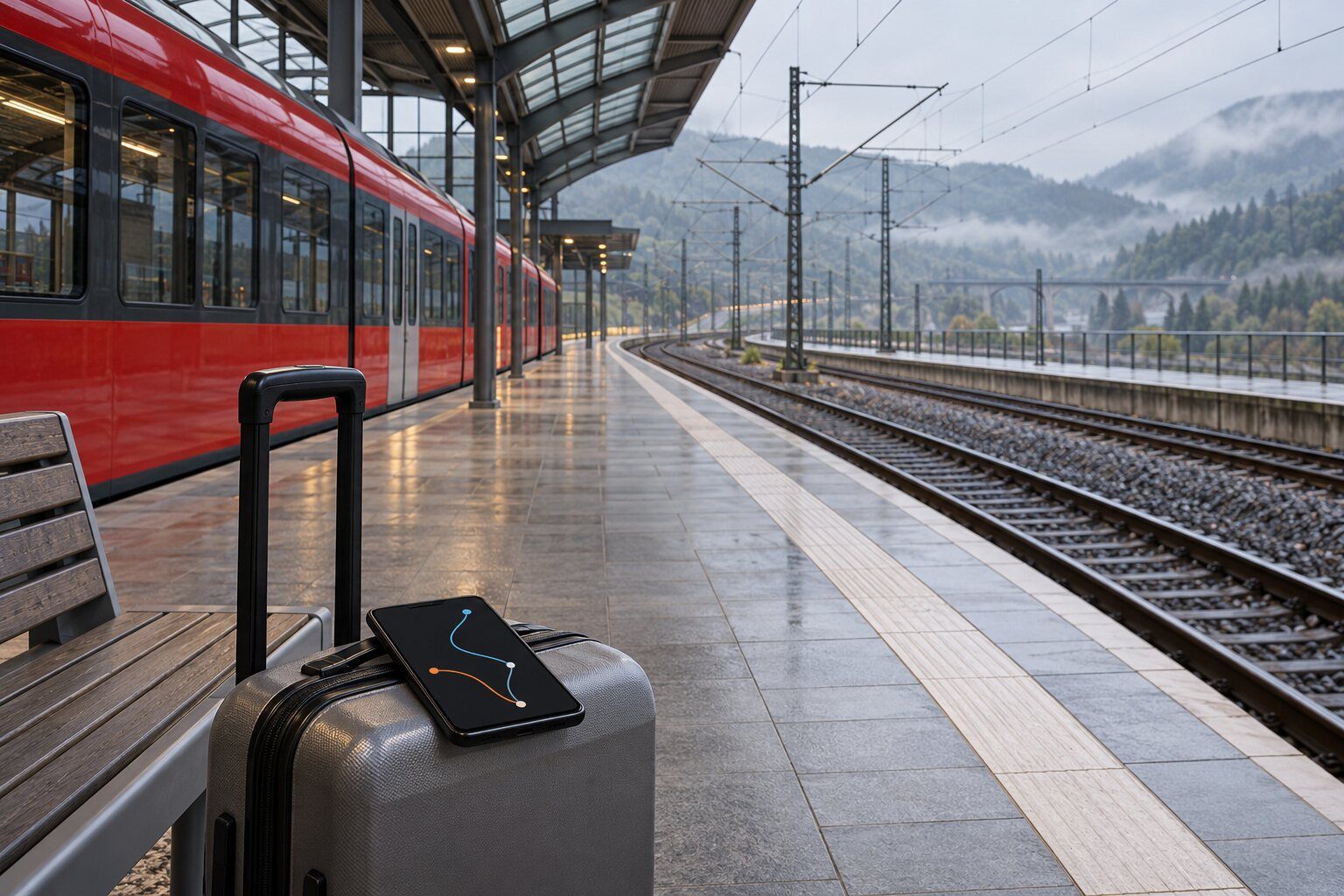
German rail travel is one of the most common situations in which visitors notice inconsistent mobile service. High speed, tunnels, cuttings, rural terrain, and repeated movement between network cells can interrupt an otherwise strong connection. Save tickets, platform information, accommodation details, and essential maps before a long train journey.
A common mistake is judging the entire journey by the signal at the departure and arrival stations. Your service may work perfectly at Berlin Hauptbahnhof and again in Munich, yet weaken during parts of the journey. The route between well-connected cities is its own coverage environment.
Train windows, carriage construction, passenger load, and rapid handovers between cell towers can all affect performance. Tunnels create obvious interruptions, but open countryside can also have gaps when the railway passes far from populated areas. A moving phone must repeatedly leave one network cell and join another, which can briefly interrupt streaming or calls.
Plan around that pattern rather than expecting continuous high-speed service. Before boarding, keep the following items available offline:
- Your ticket or boarding code
- The train number and scheduled arrival station
- Hotel address and check-in instructions
- A map of the arrival area
- Any connection details needed for the next train
Messaging often recovers quickly after a short gap because messages wait and send once the connection returns. Live calls, video meetings, and streaming are less forgiving. If a work call matters, schedule it while stationary or use station Wi-Fi as a separate backup where available.
Rural road trips need similar preparation. Download the relevant map area before departure and save the destination address in a form you can read without a connection. Do not rely on public Wi-Fi at a small station, countryside restaurant, or remote accommodation. It may exist, but it should not be your only route to navigation or booking details.
Which connection fits your trip?
Choose your connection by itinerary, usage, and trip length. Home roaming is convenient for short visits, a German carrier line can suit longer stays, and a travel eSIM plan is often the easiest middle ground when you want mobile data on arrival without replacing your primary physical SIM.
| Traveler type | Most practical option | Main reason | Trade-off to check |
|---|---|---|---|
| Light user | Small travel eSIM plan | Enough for maps, messages, and booking checks | Background updates can use the allowance quietly |
| City-break traveler | Travel eSIM plan or included home roaming | Simple access across airports, stations, and central districts | Confirm whether home roaming has daily charges |
| Heavy streamer | High-allowance travel or local option | Video can consume an allowance quickly | Check hotspot and fair-use conditions |
| Long-stay visitor | German carrier service | Direct local service may fit ongoing use | Registration, payment, and identity requirements can add friction |
| Multi-country traveler | Regional travel eSIM plan | Avoids changing service at each border | Confirm that every destination is included |
Telekom, Vodafone, and O2 sell direct local service, including eSIM options for supported devices and eligible offers. A local operator’s own eSIM can make sense if you are staying longer or need a German number. Purchase steps, identity checks, payment methods, and offer eligibility can differ, so confirm the current conditions before depending on same-day activation.
A travel eSIM usually focuses on mobile data. Your original number can remain active for incoming messages or account verification if your phone supports dual-line use. Watch your home carrier’s roaming rules, since receiving calls or using mobile data on the home line may create charges.
Public Wi-Fi works as a supplement rather than a complete connection strategy. It can reduce mobile usage at hotels and cafés, but it will not follow you along a rail platform, rural road, or walking route. Avoid using an open network for sensitive account activity unless you trust the connection and understand the security risk.
Choosing travel coverage without fixed bundles
A flexible travel service should let you match the destination, mobile data allowance, and validity period to your itinerary. That matters in Germany because a weekend in Berlin has different needs from a rail journey through several regions. Check network access, hotspot rules, activation timing, and top-up options before purchase.
If you want mobile data ready when the plane lands but do not want a fixed bundle designed for a different kind of trip, that need is where Yoho Mobile fits. You can choose Germany as the destination, select the data amount you expect to use, and choose the number of days independently. Review the available Yoho Mobile Germany eSIM options against your exact route rather than choosing only by the largest allowance.
For a light city break, prioritize enough mobile data for maps, messaging, restaurant searches, and ticket checks. If you expect daily video, cloud uploads, hotspot use, or remote work, choose a larger allowance and confirm that tethering fits your intended use. Multi-country rail travel calls for a regional selection that includes every border crossing on the itinerary.
Other choices still have real advantages. Home roaming offers the fewest setup changes when your domestic allowance already includes Germany. A local carrier service can be a better match for a long stay or a traveler who needs a German number. Public Wi-Fi can reduce usage when you are settled at a hotel. The trade-off is that each option gives you less control, less mobility, or more setup work in a different way.
If you are unsure whether your phone setup will work before relying on it in Germany, testing it before departure can reduce that risk. The Yoho Mobile free eSIM trial provides a way to check the setup while you still have reliable Wi-Fi. If your separate concern is running out of purchased data during the trip, Yoho Care provides a backup path; review how it works before departure so you know what to expect.
Do not buy solely from a coverage map or a 5G label. Look for the underlying German network, confirm that your phone is compatible, and check whether the eSIM plan starts on purchase, activation, or first connection. Those details decide whether the service matches your departure schedule.
How do you prepare your phone before departure?
Prepare the phone while you still have reliable Wi-Fi. Confirm compatibility and carrier-unlocked status, choose coverage for your route, add the eSIM profile, label both lines, and keep your home line away from mobile data. After arrival, activate the travel line and test it before leaving the terminal.
First, confirm that the exact phone model supports embedded connectivity. Model names alone are not always enough because device capabilities can differ by region. Apple maintains an official list of iPhone models that support eSIM, while Android users should check the manufacturer’s documentation and the device settings.
If you need another compatibility check before purchasing a travel plan, review Yoho Mobile’s eSIM-compatible device list. Compatibility does not guarantee that the phone is unlocked, so check both conditions. A carrier-locked device may reject another eSIM profile even when the required menu appears.
Confirm device support.Verify the exact model and check that the phone is unlocked. Continue only when both conditions are clear.
Choose coverage for your route.Match the eSIM plan to your cities, rural stops, rail journeys, expected use, and trip duration. Confirm that Germany is included.
Add the travel profile.Add the eSIM profile over dependable Wi-Fi before departure. Keep the QR code or confirmation details available on another screen in case you need them.
Label both lines.Use clear names such as Home and Germany Travel. Check which line handles calls, messages, and mobile data.
Select the travel line.After arrival, activate the travel line for mobile data and disable automatic mobile data switching. Turn on data roaming for the travel line if its instructions require it.
Test the connection.Turn off Wi-Fi, open a map, and load a current route. Once that works, you can leave the airport or station with a verified connection.
Once the travel profile is installed, keeping its usage and activation details accessible can make airport troubleshooting easier. The Yoho Mobile app for iOS and the Yoho Mobile app for Android let you manage those details in one place. Install the relevant app before departure, sign in, and keep the purchase confirmation accessible offline in case airport Wi-Fi is unreliable.
Your home line can stay enabled if you need its number for WhatsApp, bank messages, or authentication codes. Set the travel line as the only line for mobile data, and do not allow automatic switching. That prevents the phone from quietly returning to expensive home roaming when the travel connection weakens.
You can also keep your existing WhatsApp number while using a travel eSIM in Munich or elsewhere in Germany. WhatsApp normally stays registered to the existing number while the travel line supplies mobile data. If WhatsApp asks whether you want to change numbers, decline unless moving the account is your intention.
A realistic Germany connectivity checklist
Reliable internet in Germany for tourists comes from matching the network to the route, not chasing a permanent 5G icon. Prepare for city performance, rail interruptions, rural gaps, and indoor weak spots. A compatible phone, correctly selected travel line, and offline essentials give you a practical backup when coverage changes.
- Check the underlying German network before buying.
- Confirm that your exact device model supports eSIM and is carrier-unlocked.
- Choose the allowance around maps, streaming, hotspot use, and trip length.
- Add the eSIM profile before departure over stable Wi-Fi.
- Keep your home line away from mobile data unless Germany is included.
- Save train tickets, hotel details, and important maps offline.
- Expect 4G to remain useful even when 5G is available.
- Test the travel line before leaving the airport or station.
For a city break, most established networks can handle ordinary travel tasks. For regional trains, countryside drives, and remote work, favor broader network reach and keep an offline fallback. Germany’s mobile service is capable, but it is not uniform. Your itinerary is the real coverage test.
Frequently Asked Questions
Travelers usually want to know whether they can keep their number, expect continuous 5G, trust one carrier across Germany, or avoid home roaming charges. The answers depend on phone settings, route, and service terms, but a few practical rules resolve most concerns before departure.
Can I keep my WhatsApp number with a travel line in Munich?
Yes. WhatsApp normally remains registered to its existing number when you use another line for mobile data. Decline any prompt to change the registered number unless you actually want to move the account.
Does 5G work everywhere in Germany?
No. Availability depends on the carrier, location, buildings, phone, and network load. Your phone may move between 5G and 4G during the same city visit or rail journey.
Which German carrier is the strongest default for a mixed itinerary?
No carrier is guaranteed to be strongest across every rural stop and intercity route. Telekom has a strong result in the cited national connectivity testing, but that does not identify the best network for a particular journey. Compare Telekom, Vodafone, and O2 coverage information with your itinerary, then check which underlying network each travel service uses.
Should data roaming be turned on for a travel line?
Many travel lines require data roaming on because they connect through partner networks. Keep roaming off for your home line unless your home carrier confirms that your allowance includes Germany.
What if my phone is locked to my home carrier?
A locked phone may reject another carrier profile even when the device supports embedded connectivity. Ask your home carrier about unlocking before departure or use another unlocked device.